
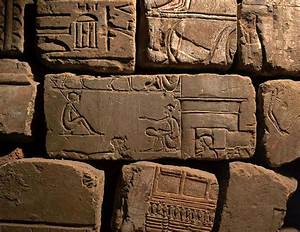
The End of Egyptian Dynasty XVIII
Blocks Horemheb Recycled from Ankenaten’s Temple
Episode 23 The End of Dynasty XVIII
The History of Ancient Egypt
Professor Robert Brier
Film Review
Ay, the former vizier (prime minister) who succeeded Tutankamen by marrying his widow. ruled from 1325-1321 BC. His reign continued to steer away from Ankenaten’s monotheistic heresy (see Egypt’s Ankenaten: The World’s First Montheistic Ruler). Ay buried west of the Valley of the Kings in a tomb originally built for Tutankamen.
His successor Horemheb (1320-1292 BC) was a military man who served Tutankamen’s father Amenhotep (as King’s Deputy). He stayed behind in Memphis when Ankenaten moved the capitol to Akhetaton. Under Tutankamen, he served as Recorder of Royal Laws. He married Mutnedjme, believed to be the sister of Nephriti. As a commoner, it’s likely he used military force to seize the throne.
Associated with Tof, the god of writing, Horemheb ruled for 28 years, trying to erase all temple inscriptions pertaining to Ankanaten, Tutankamen and Ay.
The new policies he initiated were
integrating the priests (owing to their immense power) into the military to bring them under closer control
appointing a separate military commander for northern and southern Egypt
launching an immense program of building projects, include pylons at Karnak constructed from the blocks of Ankenaten’s temple (which he disassembled).*
Horemheb also usurped all Tutankamen’s monuments (which was why it took Egyptologists so long to learn Tutankamen existed), carving out Tutankamen’s name to replace it with his own.
*A virtual model of this temple has been created via computer to reconstruct the original inscriptions.
Film can be viewed free on Kanopy with a library card.
https://www.kanopy.com/en/pukeariki/watch/video/1492791/1492846
About The Author

Discover more from MEK Enterprises Blog - Breaking News, SEO, Information, and Making Money Online!
Subscribe to get the latest posts sent to your email.